Demystifying Passive Design in Extreme Climates
Excerpt
Excerpt
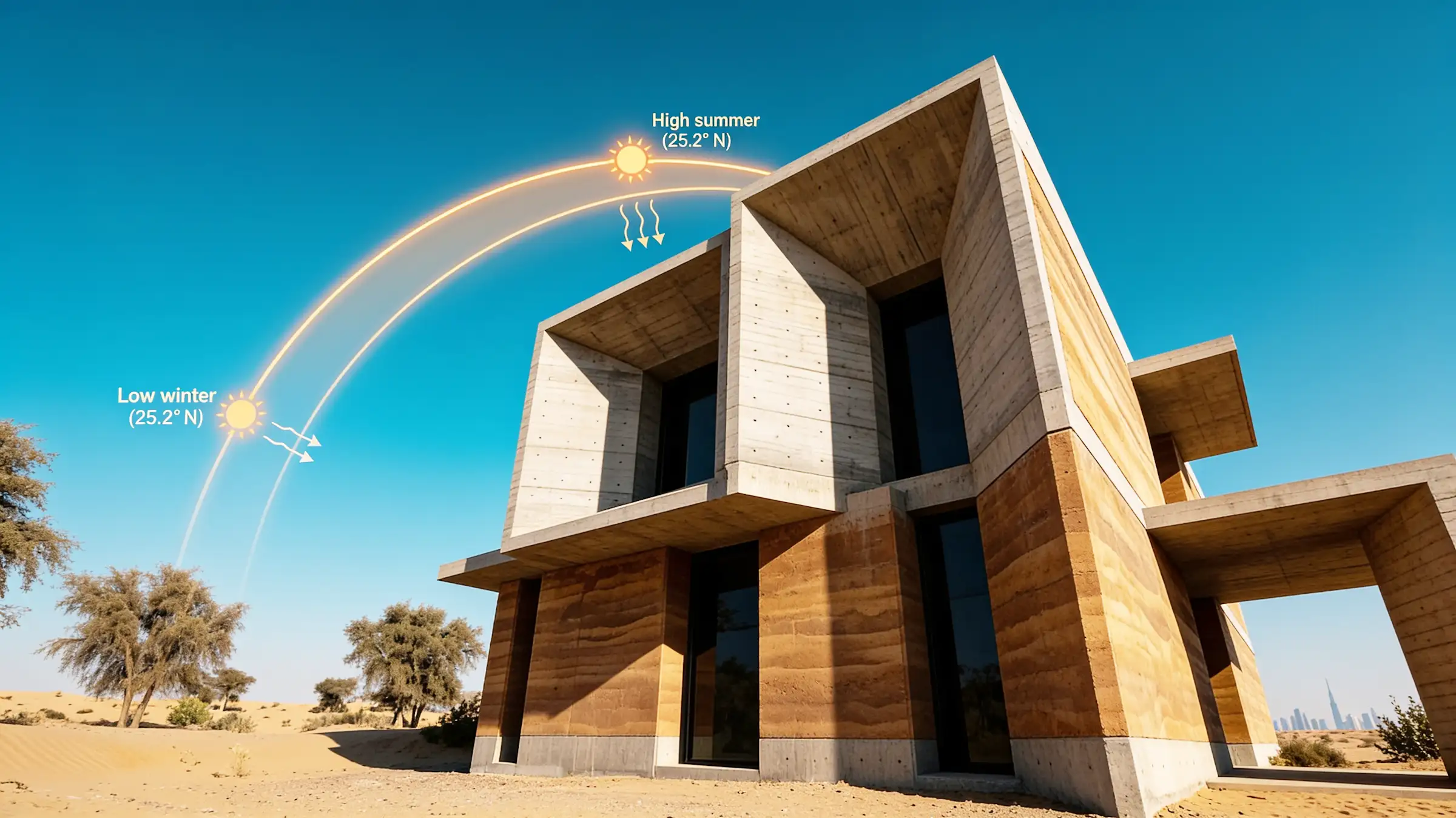
Sustainability is a design decision, not a post-construction certification. We explore how thermal mass and orientation naturally reduce energy loads in harsh environments.
Insight
The conversation around sustainable architecture has been heavily skewed toward active technological solutions—solar panels, smart BMS systems, and high-efficiency mechanical cooling. While these are critical, true environmental performance begins much earlier. It begins with passive design.
The Foundation of Sustainability Passive design utilizes the fundamental geometry, orientation, and materiality of a building to control its internal climate. In extreme environments, these decisions are not optional; they are survival mechanisms. A glass box facing direct western sunlight cannot be made truly sustainable, regardless of how efficient its air conditioning unit is.
Thermal Mass and Shading Our practice prioritizes deep, recessed apertures, heavy thermal mass materials like rammed earth or reinforced concrete, and precisely calculated overhangs. By studying the solar path and prevailing winds before the first floor plan is drawn, we can drastically reduce the mechanical cooling load before a single piece of equipment is specified.
Summary
Looking Forward We are continually refining our passive design models, integrating advanced environmental simulation software directly into our initial massing studies to ensure every project starts from a position of environmental logic.
Let’s Collaborate

Stay Connected
Join our newsletter and stay updated on the latest trends in digital design.
Quick Contact
TECOM Business Center, 1st Floor, Building #8
Dubai Media City, Al Sufouh 2, Dubai, U.A.E
+971 (50) 257 6985
info@abubaker.org